
Cumberland Court Records After Arrest
After a Cumberland County jail arrest, the first public record may be the custody entry in the BlueHorse roster. That entry can show booking charges, bond fields, detainers, arrest agency, court dates, and housing details. The court record is different. It starts to matter when a complaint, summons, warrant, indictment, accusation, or municipal complaint is filed and tracked by the judiciary. The Cumberland County Prosecutor's Office reviews indictable criminal matters, while municipal courts handle many traffic, ordinance, disorderly-persons, petty disorderly-persons, and lower-level complaint matters.
The jail record is a snapshot of custody. The court record is the case trail. Prosecutor review can approve charges, amend them, downgrade them, dismiss them, supersede them by indictment, or send some matters into municipal court. A person can be booked on one charge set and later have a different filed charge list. That is why custody questions belong with the jail roster, while court records after a jail arrest belong with NJ Courts, the municipal court portal, the clerk, and the prosecutor or court handling the case.
Find Court Records After Arrest
The main online entry point is the NJ Courts Find a Case hub. Public database availability depends on the case type. Criminal judgment searches can use defendant name, SBI number, complaint number, or indictment number when available. Municipal traffic and complaint matters use the Municipal Court Case Search, which is a separate portal. Older files, sealed or restricted matters, and documents not exposed through public portals may require a clerk request or in-person court channel.
- Start with the court system, not the jail roster, when the question is filed charges, hearing status, or case outcome.
- Search by defendant name first. Add the SBI number, complaint number, indictment number, ticket number, or municipality if known.
- Open the matching case and compare each charge, date, and case number with any jail profile data.
- Check whether the matter is Superior Court, municipal court, or another database. A single arrest can create more than one searchable record.
- Use the clerk or court-record request process for missing documents, older records, sealed items, or records not shown online.
The NJ Courts case-search hub is the central place to start when the issue is court records after a Cumberland County arrest.
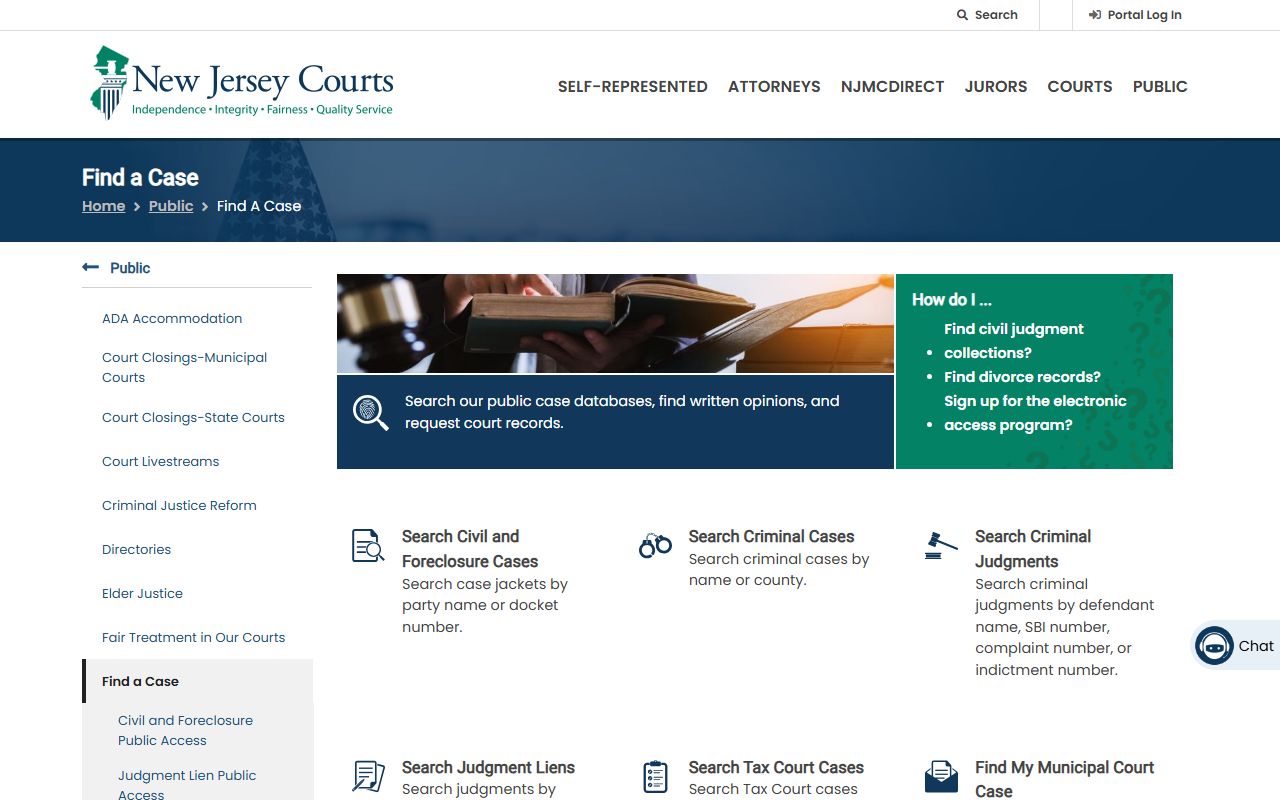
For municipal complaints, traffic matters, and many local lower-level cases, the separate municipal portal may be the better fit.
Cumberland Case Search Fields
Cumberland County court records after arrest can be easier to find when a jail record provides an OTN, case number, complaint number, or State ID/SBI clue. Not every roster field maps cleanly into a public court database, but those identifiers can narrow a name search. The portals are statewide, so use local court, municipality, charge, or date clues to avoid confusing a Cumberland County case with a same-name case elsewhere in New Jersey.
| Field Label | Portal | Use | Notes |
|---|---|---|---|
| Defendant name | NJ Courts criminal judgment search | Start when no number is known. | Try spelling variants and middle initials for common names. |
| SBI number | NJ Courts / NJDOC context | State identifier. | Best when copied from paperwork or a reliable record. |
| Complaint number | NJ Courts / municipal portal | Complaint-based case search. | Useful after a jail arrest or summons complaint. |
| Indictment number | NJ Courts | Superior Court indictable matter. | Often appears after grand jury action. |
| Name, complaint, or ticket fields | Municipal Court Case Search | Municipal complaint or traffic search. | Use the Cumberland municipality when known. |
Charges After Cumberland Arrest
The arrest to court path can start with a complaint-warrant or complaint-summons. If the person is detained, the jail creates the custody record. Then a court or prosecutor process controls what charges move forward. New Jersey terminology differs from many states. "Information" is less useful here than complaint, accusation, and indictment. An accusation can be used when indictment is waived, and an indictment is the grand-jury charging document for many Superior Court matters.
| Complaint | Accusation | Indictment | |
|---|---|---|---|
| Common Source | Police, complaint-warrant, or complaint-summons process. | Prosecutor-led Superior Court filing when indictment is waived. | Grand jury action in an indictable criminal case. |
| Common Use | Starts many criminal, municipal, traffic, or lower-level complaint matters. | Can move an indictable case forward without a grand jury indictment. | Formal charge document for serious Superior Court cases. |
| Record Clue | Complaint number, court, charge text, or OTN from jail or court papers. | Superior Court case information and prosecutor paperwork. | Indictment number and filed count list. |
Cumberland County Prosecutor's Office is the relevant prosecuting agency for indictable county criminal matters. The office is listed at 115 Vine Street, Bridgeton, NJ 08302, and the prosecutor website provides news, most-wanted, missing-person, resource, tip, and victim-related tools. That office is not the same as the jail, and it does not run the jail roster.
Cumberland Charge Status Terms
A charge status is not a conviction. It is a point in the court process. Cumberland County court records after a jail arrest may show charges that are pending, amended, downgraded, dismissed, diverted, pled, convicted, acquitted, sentenced, expunged, or sealed. The jail roster may display disposition fields too, but the court case is the better source for final status.
| Status | What It Means |
|---|---|
| Pending | The charge remains open. Future hearings, review, plea talks, diversion, or trial may still occur. |
| Amended or reduced | The filed count changed after review, negotiation, downgrade, indictment, or court action. |
| Dismissed | The charge was ended by court or prosecution action. It is not the same as an expungement. |
| Diverted | The case may move through a program or condition-based path instead of standard conviction sentencing. |
| Convicted or pled | The person was found guilty or entered a plea to a charge or amended charge. |
| Expunged or sealed | Public access may be limited after a court grants relief under New Jersey procedures. |
Bond After Cumberland Arrest
New Jersey release decisions do not work like a simple cash-bail model in many new criminal cases. A person may be released on a complaint-summons, booked and released with conditions, held for a first appearance, or detained while a prosecutor seeks detention. Cumberland County jail profiles can show bond fields and detainers, but those fields do not prove that payment alone will release the person. Confirm release rules with the court or jail before traveling or paying anyone.
| Release or Hold Type | How It Works |
|---|---|
| Release on recognizance | Court release without a money bond, often with non-monetary conditions. |
| Monetary bond | May appear in warrants, municipal matters, older cases, out-of-state holds, or special contexts. |
| Detainer | A hold from another court, agency, warrant, parole, probation, federal, ICE, or out-of-county matter. |
| No-release hold | A court order or detainer prevents release even if another line appears payable. |
Check the Bonds and Detainers tabs on the jail profile if those tabs are public, then compare court dates and case numbers in NJ Courts. For custody status or release logistics, the Cumberland County Department of Corrections main number is the local jail channel. For court orders and hearing status, use the court system rather than the jail alone.
Cumberland Warrants and Court Holds
No official countywide active-warrant database was found in the research. Warrants still matter because they can explain an arrest, a jail booking, a detainer, a no-release hold, or a bond entry. BlueHorse detainer fields can show description, agency, bond amount, and bond type. A bench warrant may also appear through court records, especially when the issue is failure to appear or violation of a court order.
Use the jail roster for detainers and bond fields, NJ Courts or Municipal Court Case Search for case-level warrant clues, and the Cumberland County Prosecutor's Office site for public fugitive or most-wanted notices. The sheriff's site has a community interface and tip tools, but the research did not find a full active-warrant search. Federal warrants are separate and may involve the U.S. Marshals District of New Jersey.
Charges vs Convictions
Being arrested, booked, or charged is not the same as being convicted. A charge is an accusation that must move through court. A conviction comes from a guilty plea, verdict, or other final adjudication. Cumberland County court records after arrest should be read with that difference in mind, especially when the public record still shows pending or dismissed charges.
| Charge | Conviction | |
|---|---|---|
| Stage | Accusation after complaint, summons, warrant, accusation, or indictment. | Final result after plea, verdict, or court finding. |
| Proof Level | Based on probable cause or filed allegations. | Requires plea or proof beyond a reasonable doubt. |
| Record Meaning | May be pending, amended, downgraded, dismissed, or diverted. | Can affect sentence, supervision, custody, and later record-clearing analysis. |
Sealed and Expunged Records
New Jersey court records may be limited by sealing, expungement, juvenile rules, privacy rules, investigation limits, or court access rules. The NJ Courts expungement self-help materials explain the process for eligible records. A dismissal does not always remove public access by itself. A court order may be needed, and eligibility depends on the case history, disposition, timing, and offense type.
| Sealed | Expunged | |
|---|---|---|
| Public Visibility | Hidden or restricted from public view by court rule or order. | Isolated from ordinary public access after a court grants expungement. |
| Law Enforcement | May retain limited access where law allows. | May retain limited access for specific legal purposes. |
| How It Happens | Often tied to juvenile, protected, or restricted case categories. | Requires eligibility and a New Jersey court expungement process. |
OPRA and Court Limits
New Jersey OPRA favors access to government records, but court records are not always obtained through county OPRA. Cumberland County OPRA and NextRequest are useful for county agency records such as jail records, public-record requests, and some local agency materials. Judiciary records often follow court rules and court request procedures. N.J.S.A. 47:1A-3 also allows limits for ongoing investigations while requiring certain arrest, charge, and bail information to be available within 24 hours or as soon as practicable unless an exception applies.
Important: Public court records, jail roster entries, and background reports are different products and should not be used as substitutes for one another.
Restricted Cumberland Court Records
Some court records after arrest are missing from public searches for lawful reasons. Juvenile matters, sealed files, expunged matters, medical or mental-health details, active investigation records, victim-related protections, and security-sensitive records can be withheld or redacted. OPRA also preserves exemptions, and Executive Order 69 limits access to certain criminal-investigation photographs and similar records. For booking-photo issues, use the separate Cumberland County jail mugshots resource because photo access follows a different legal analysis than filed charges.
VINE is a helpful notification option where available. It can send custody or criminal-case updates after registration, but it is not a court docket, prosecutor file, jail roster, or records custodian. Use it for notice, then verify important dates, orders, release terms, and dispositions with the official court or jail source.
Public Record Search
Sponsored Results